The Monorail's story: 1962 to today
Updated November 18, 2026
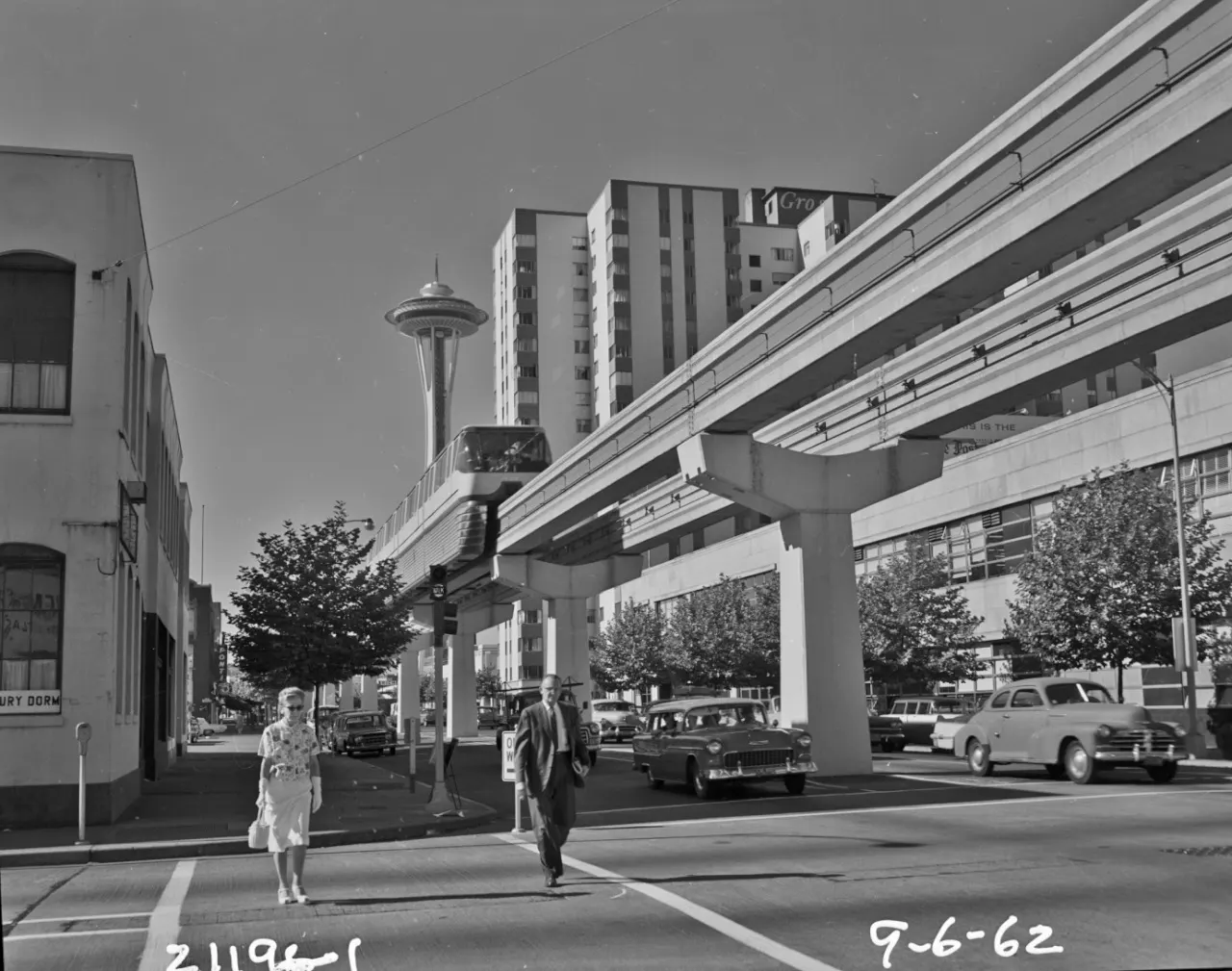
- Opened
- March 24, 1962
- Trains
- The original Red and Blue
- Seattle landmark
- Since 2003
- Riders today
- About 2 million a year
Six dates
- 11962Opens March 24, a month before the World's Fair; most fairgoers ride it.
- 21965The City of Seattle buys the line after the fair.
- 31989A new downtown station opens inside Westlake Center.
- 42004–2006A fire, then a collision; both trains are back by August 2006.
- 52019ORCA cards work at the gates.
- 62026The Seattle Center station's rebuild begins.
Built for one summer
Seattle's 1962 World's Fair, the Century 21 Exposition, wanted to show off the future, and a train on a single concrete beam fit the theme. Alweg Rapid Transit Systems, part of the Swedish-owned Alwac International, signed the contract in December 1960 and broke ground on April 6, 1961. The line opened on March 24, 1962, about a month before the fair, and HistoryLink counts about 7.4 million of the fair's 9.6 million visitors among its riders.
Two four-car trains were built: the Blue on the west track and the Red on the east. They are the same two trains you ride today.
After the fair
The City of Seattle bought the Monorail in April 1965. The original downtown terminal over Pine Street closed in 1986 while Westlake Center was built, and the station you use today, on the mall's 3rd floor, opened on February 24, 1989. Since 1994 a private company, Seattle Monorail Services, has run it for the City, paying its way from fares rather than a public operating subsidy. In 2003 the City named the two trains a Seattle landmark.
Two hard years
On May 31, 2004, a fire broke out on the Blue train near the Seattle Center end; passengers were brought down by ladder, and eight had minor injuries. On November 26, 2005, the two trains scraped each other on the tight curve near Westlake, where the tracks run close. Repairs took until August 11, 2006.
Between those two accidents, on November 8, 2005, Seattle voters ended a much bigger plan: the Seattle Monorail Project's Green Line, which they had backed four times before.
The Monorail now
- 2019: every ORCA card works at the gates, on the same card as buses and Link.
- 2021: the Westlake Center station was rebuilt, largely with private money tied to Climate Pledge Arena, before the arena opened.
- 2026: the Seattle Center station's rebuild started in the fall, with a new ramp, a level platform and wider doors; at least one train keeps running.
It still carries about two million riders a year. Ride it yourself with the Monorail guide: hours, fares and the way from SEA.
Flying in to see it?
Book a private ride from SEA to Seattle Center with a licensed partner, the fare shown before you book.
Book a rideSources
Checked November 18, 2026. Rules and schedules change; the linked source is the one to trust.
- Seattle Center Monorail (Essay 2524), HistoryLink. Alweg contract and groundbreaking, March 24, 1962 opening, fair riders, the two trains, the 1965 purchase, the Westlake stations of 1986 and 1989, the 2003 landmark, the 2004 fire and 2005 collision, the 2006 return.
- Seattle voters reject the monorail (Essay 7638), HistoryLink. The November 8, 2005 vote ending the Seattle Monorail Project.
- Frequently asked questions, Seattle Center Monorail. Seattle Monorail Services as operator since 1994; City ownership.
- Seattle Center Monorail now part of the ORCA family, Sound Transit. ORCA accepted from 2019; about 2 million riders in 2018.
- Seattle Center Monorail station work, Seattle Center. The 2021 Westlake station rebuild ahead of Climate Pledge Arena.
- Monorail station renovation begins, KOMO News. Seattle Center station rebuild from fall 2026 into 2027; one train keeps running; the ramp, platform and doors.
- Monorail to nix transfer credits, The Urbanist. Riders above 2 million in 2024; fares cover operations without a public operating subsidy.